
What is a fund, and how a master fund is structured
What is a fund, and how a master fund is structured
A fund is a pooled investment vehicle that takes capital from multiple investors, deploys it into a defined strategy, and pays the proceeds back pro rata. The vehicle has its own legal personality, its own governance, its own books. Investors hold units or shares of the fund. The fund itself owns the assets.
That last point separates a fund from a managed account. In a managed account, you still own your apples; the manager just trades them on your behalf. In a fund, you own a slice of the basket. The fund signs the contracts, files the tax returns, and gets sued if something breaks. The investor sits one layer back.
How a master fund is structured
Investors don't all look the same. A US tax-exempt pension is regulated differently than a Cayman family office. A Japanese insurance carrier has settlement constraints a Swiss UCITS fund doesn't share. If they all want to back the same strategy, the structure has to absorb those differences (different tax treatments, different regulators, different reporting cycles) without forcing every LP through the same plumbing.
Master-feeder solves it. One master fund, two or more feeder funds, all stacked.
The master fund is the deployment vehicle. It sits in a tax-neutral jurisdiction (Cayman Islands and Bermuda dominate; Luxembourg, Ireland, and the BVI also show up) and holds the actual portfolio: the loans, the bonds, the tokens, whatever the strategy is. The master has one investor type: feeder funds.
A typical setup runs two feeders. The US feeder, formed as a Delaware limited partnership, takes tax-exempt and taxable US LPs; the offshore feeder, formed as a Cayman exempted company, takes everyone else. Each feeder runs its own books. Subscriptions, KYC and AML reviews, tax filings: those all happen at the feeder level before cash gets routed up to the master.
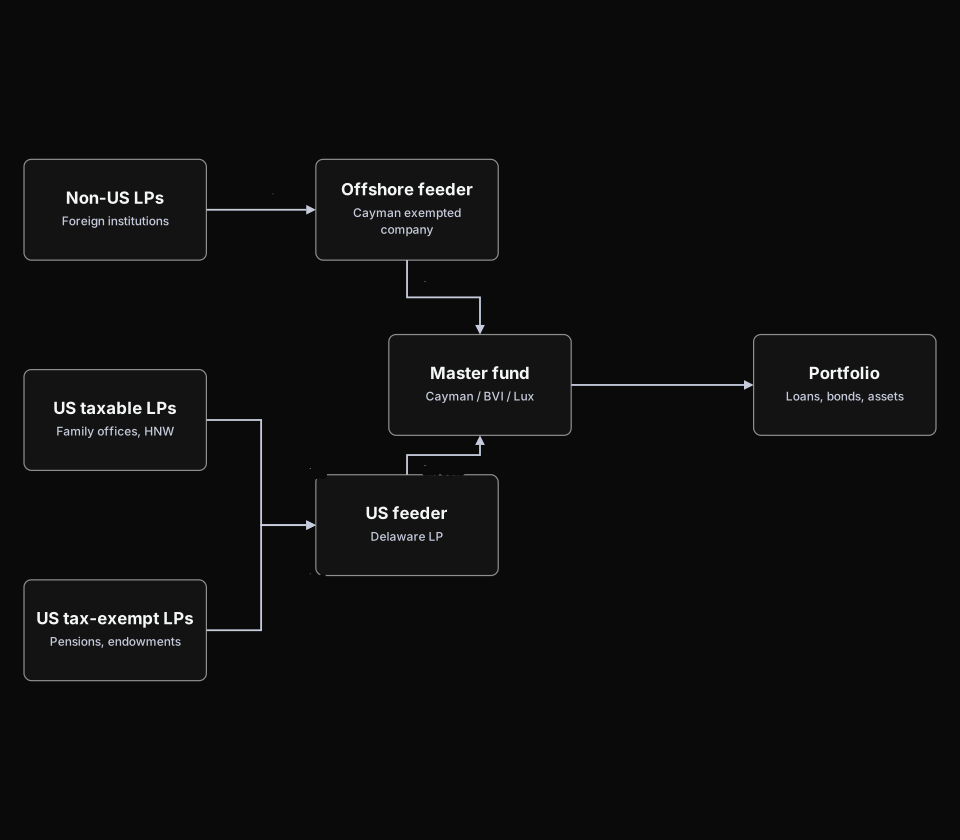
Returns flow the other way. The master earns from the portfolio, distributes to the feeders, and each feeder distributes to its own investors in the form they expect.
Why it matters
Three problems make master-feeder the standard. Tax is loudest. US tax-exempt LPs lose their exemption if they invest in something that throws off unrelated business taxable income, so the offshore feeder is engineered as a corporate blocker that absorbs the income before it hits the LP. Non-US LPs face the mirror problem. They don't want US tax filings just because they share a strategy with a US pension. Two feeders, one master, separate forms.
Regulation comes next. A vehicle marketed to US accredited investors is governed by different rules than one marketed to qualified investors abroad. Mixing them under one entity invites problems no general counsel wants on the books.
Operations comes third. One master fund means one set of trades, one risk book, one custody account. The complexity of multiple investor classes sits in the feeder layer, where it belongs.
The alternative, a single fund that tries to onboard every investor type directly, ends up either narrower (excluding investor classes the strategy could serve) or messier (carrying compliance overhead it has no business carrying). It's not a real option at institutional scale. Master-feeder is the structure the industry settled on because it scales without forcing those compromises.
Where this shows up in institutional crypto
The same logic applies in tokenized real-world asset finance, with one extra wrinkle. The on-chain deployment side has its own segregation and counterparty-onboarding obligations, distinct from the LP-facing side. That's what shapes the dual-fund structure Rekord uses, and it's the reason every serious institutional RWA protocol you encounter in the wild ends up as two entities connected through a market, not one.