
Covenants, defaults, and what a covenant breach really means
Covenants, defaults, and what a covenant breach really means
A covenant is a binding promise inside a loan agreement. The borrower agrees to do certain things, avoid others, and stay within specific financial bounds for the life of the loan. A breach of any covenant gives the lender the right to declare default, even when every payment has been made on time.
That last part trips people up. Most people equate default with a missed payment. That's one path to default. Tripping a covenant is another, and in private credit it's the more common one.
How it works
Covenants come in three flavors.
Affirmative covenants are the do-list: file audited financials by a fixed date each year, maintain property and liability insurance on pledged assets, notify the lender before changing auditors or replacing senior management. The list can run to dozens of items.
Negative covenants are the don't-list: no additional debt above a stated limit, no asset sales without consent, no dividends to shareholders while the facility is outstanding.
That handles behavior. Numbers are the third category.
Financial maintenance covenants set thresholds the borrower has to live within: a debt-to-EBITDA ratio under 4.0x, a debt service coverage ratio above 1.25x, a What is LTV below 70%.
When any of these gets tripped, the borrower's in technical breach. What happens next depends on the contract. Most agreements include a cure period, often 30 or 60 days, where the borrower can fix the problem before the lender takes formal action.
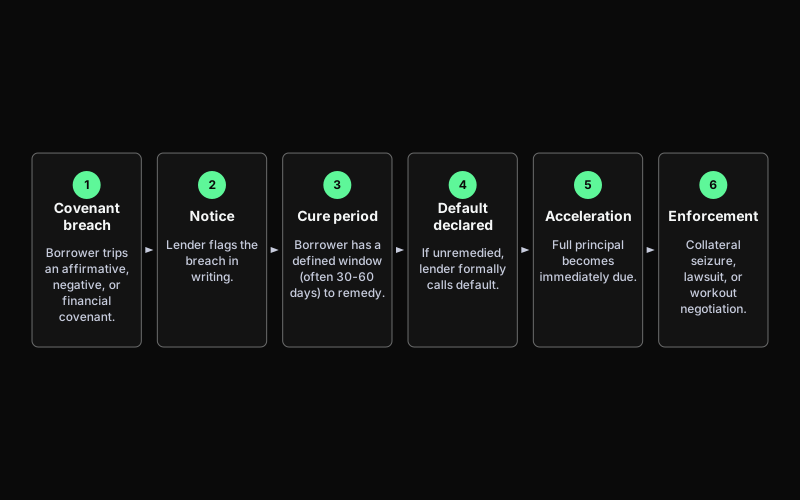
If the cure period expires without remedy, the lender can declare default. That triggers acceleration: the entire outstanding principal becomes immediately due, regardless of the original maturity. Most loans never get there. Lenders prefer renegotiation (extending duration, raising the rate, taking additional collateral) to enforcement, because forced liquidation tends to recover less than orderly restructuring.
Take a $50 million SMB loan with a debt-to-EBITDA covenant of 4.0x. The borrower's EBITDA drops in Q2, the ratio hits 4.3x, and the breach shows up in the Q3 financials filed in November. The lender sends a notice, the borrower has 60 days to either inject equity or sell a non-core asset to bring the ratio back, and if neither works, the parties usually negotiate a covenant waiver in exchange for a fee, a higher rate, or a tighter ratio for the next year.
Why it matters
Covenants exist because lenders need an early-warning system. Payment default is a lagging indicator: by the time a borrower can't pay, the credit's already gone bad. Financial covenants sit upstream, catching deterioration before the cash runs out.
The catch is the visibility lag. Most loan covenants get checked quarterly, against financial statements that arrive 60-90 days after the period closes. A borrower can breach a ratio in February, file the statements in May, and only then trigger a notice from the lender. By that point, the deterioration's three months old. Continuous covenant monitoring is the operational answer to that lag, and it's one of the things that separates modern private credit infrastructure from the manual processes most of the industry still runs on.
For unsecured lending, covenants are often the only protection a lender has, since without collateral to seize, the right to declare default and accelerate the principal is the lever the lender pulls when things go wrong. For Secured vs unsecured lending, they layer on top of the collateral, providing a second line of defense if asset values move before liquidation can happen.
Where this shows up in Rekord
In crypto-collateral lending, the live covenant is LTV. The threshold is enforced continuously by the protocol, prices update in seconds, and breach to liquidation can happen in the same block. There's no quarterly statement, no 60-day cure, no negotiation. The mechanics carry over from traditional credit; the timing collapses from months to seconds.
For how that works in practice, see LTV vs LLTV: origination threshold vs liquidation trigger.