
What is Private Credit? The $1.7T Asset Class Explained
What is private credit
Private credit is debt extended outside public markets and outside the regulated banking system. The lender is a fund. The borrower is usually a private company, a private equity portfolio company, a real estate sponsor, or a specialty finance platform that doesn't fit the syndicated loan or public bond machinery. The loan is privately negotiated. It isn't registered, isn't rated by Moody's or S&P, and doesn't trade on a secondary market in any meaningful size.
The asset class crossed $1.7 trillion in AUM in 2024, up from roughly $500 billion in 2015. Apollo, Ares, Blackstone Credit, KKR, Blue Owl, Oaktree, and a long tail of smaller managers run most of it. Direct lending (senior secured loans to middle-market companies) makes up the bulk. Mezzanine, distressed debt, specialty finance, and opportunistic credit fill out the rest.
How it differs from public credit and bank lending
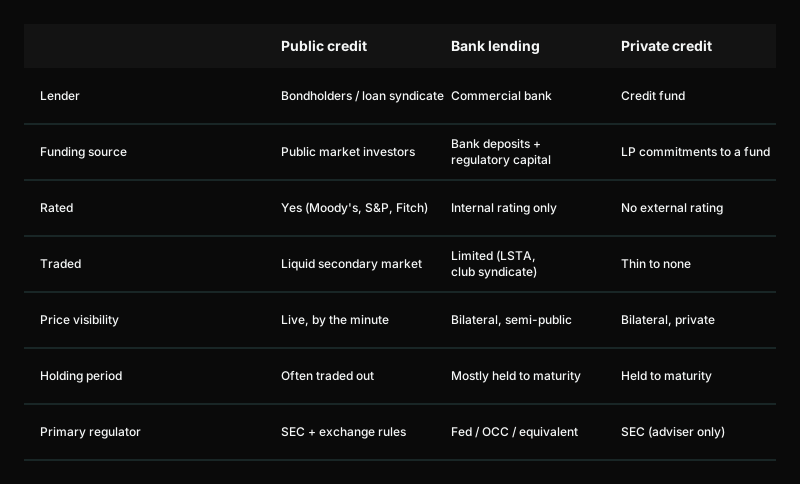
Three rails carry corporate debt: the public bond market, bank balance sheets, and private credit funds. They look similar on a term sheet and behave very differently in practice.
Public credit means bonds and syndicated loans. The issuer files prospectuses, gets rated, and the paper trades on a secondary market where prices are visible by the minute. A high-yield bond from a $5 billion issuer is liquid in size: a portfolio manager can sell $50 million on a Tuesday without moving the market more than a few basis points.
Bank lending sits on a bank's balance sheet, funded by deposits, regulated by capital rules (Basel III, the supplementary leverage ratio, large-exposure limits). A bank revolver to that same $5 billion company is bilateral or club-syndicated, priced off SOFR, and held mostly to maturity. The whole thing answers to a regulator checking risk-weighted asset density every quarter.
That leaves private credit. The fund commits capital. The borrower draws it down. There's no rating, no trading desk, no public price. The fund holds the loan until maturity, or sells the position in a thin secondary market when it has to. Pricing is bilateral: SOFR plus a spread the GP negotiates with that specific borrower.
Why it matters
The growth has come from capital that used to sit in bank loan books. After 2008, Basel III pushed up the capital banks have to hold against middle-market loans, and Dodd-Frank pushed down what they could do with leveraged lending. Banks retreated from the segments they used to dominate. Funds filled the gap.
For investors, private credit pays a premium to public credit for the same nominal seniority. Direct lending to a middle-market borrower yields several hundred basis points above the equivalent rated bond in the public market. The premium compensates for illiquidity, the cost of doing private credit analysis on borrowers nobody else has analyzed, and the fact that the loan can't be traded out of when conditions change.
For borrowers, private credit buys certainty of execution, looser covenants, faster timelines, and access to sizes and collateral types that the public bond market or a bank's underwriting won't accommodate. The trade-off is price. A direct loan from Ares or Blue Owl costs more than the same nominal debt from a syndicated bank facility, when the bank facility is available at all.
Where this shows up in Rekord
Most of Rekord's RWA Pools allocate to private credit deals: direct middle-market lending, trade receivables financing, consumer credit portfolios, SMB acquisition debt, commercial real estate development. Each one is a private credit instrument with its own risk shape. The pool aggregates them, smooths the cyclicality, and packages the result as a single LP-facing position. For the full mechanics, see The capital cycle: how stablecoin deposits become real-world returns.