
What Rekord Does: An Overview of Provable Finance
What Rekord does: an overview of Provable Finance
The concept in plain language
Provable Finance is real-world asset finance where every claim about collateral, cashflow, or compliance can be independently checked against cryptographic records, instead of being trusted on the word of a quarterly report.
Rekord builds the infrastructure that makes this possible. The product line covers two adjacent surfaces: financing against real-world and crypto-native collateral (lending and pools), and continuous verification of the data those positions depend on (anchoring, scoring, regulatory passports).
The underlying claim is simple. Most real-world asset finance still runs on a schedule of statements and site visits.
A borrower's covenants get checked when the report comes in. A manufacturer's disclosures get audited when the regulator asks.
Between those moments, the truth and the record drift, and the lender, the auditor, or the regulator has to trust that nothing important changed.
Continuous verification closes that gap. Every input that matters gets anchored to a tamper-detectable record as it arrives, and any authorized party can pull the chain and check it themselves.
How real-world asset finance gets verified today
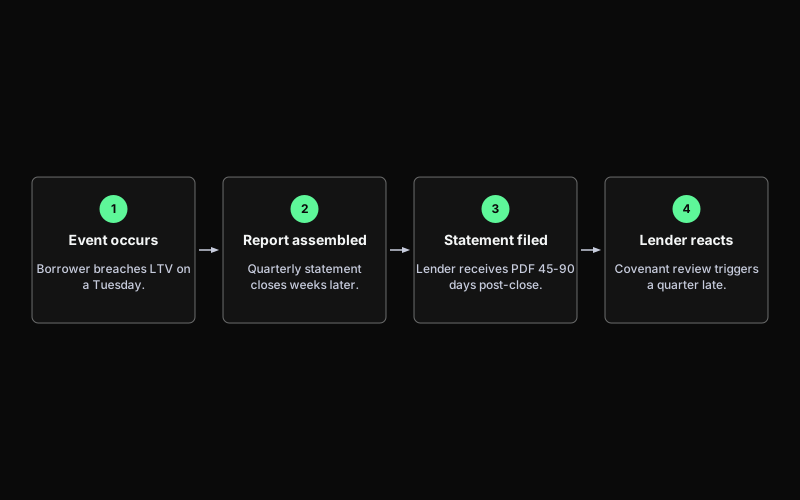
Take a $50 million private credit position. The lender originates it, files the documents, and then waits.
Quarterly financials arrive 45 to 90 days after period close. Covenant compliance certificates come stapled to those financials.
Site visits happen annually if the lender insists, or never if they don't. Audit cycles run on their own clock, and the auditor reads the same documents the borrower handed over.
The same pattern shows up in regulatory compliance. EU battery passports, supply chain due diligence, sustainability disclosures.
The regulation specifies what data must exist. It doesn't specify how that data gets verified after the filing date.
The manufacturer files what they file, the regulator reads what they read, and the gap in between is one of trust.
Cryptographic anchoring changes the surface of the problem. A record gets a hash.
The hash gets committed to a public ledger at a known timestamp. Any later attempt to change the record (silently swap a figure, backdate a covenant certificate) breaks the hash chain in a way an auditor can detect.
Cryptographic anchoring is an old idea. Bitcoin proved you could anchor a sequence of events tamper-detectably in 2009, and notary services have used hash chains for decades. What's new is the assembly: an end-to-end pipeline from off-chain data through structured schemas, anchoring, retrieval, and presentation that a credit committee or a regulator can actually rely on, rather than a stunt that ends at the hash.
That's the assembly Rekord builds.
How Rekord implements Provable Finance
The platform has three surfaces.
Financing. Rekord runs an institutional lending stack built on Morpho Blue and MetaMorpho V2. Two personas use it: institutional liquidity providers who supply stablecoin capital and earn returns from a diversified credit book, and collateral pledgers (foundation treasuries, validators, institutional crypto holders) who borrow stablecoins against pledged digital assets without selling them. It's a familiar shape.
Capital flows through bankruptcy-remote SPVs with institutional-grade legal protections. A separate deployment entity puts capital into real-world credit strategies. The two legs connect through an on-chain market that serves as an arm's-length bridge, mirroring the master-feeder structures TradFi funds have used for decades.
See The dual-fund structure: why institutional RWA protocols use two entities and The capital cycle: how stablecoin deposits become real-world returns.
The credit book blends seven deal types. Each is scored on a common 0-10 risk scale and combined under industry-standard credit math (PD, LGD, EAD, Expected Loss). Crypto collateral is overcollateralized at conservative LTVs and hedged at origination through option structures.
RWA collateral runs against type-specific monitoring and continuous covenant checks. See What is hedging? Options, puts, calls, and why lenders use them and Crypto-collateral lending as a yield source in diversified pools.
Continuous verification. Underneath every position sits the anchoring layer. Collateral attestations, custody confirmations, price feeds, covenant data, valuation updates: all of it gets schema-enforced, hashed, and committed on a continuous cadence.
The lender doesn't read a quarterly statement that summarizes what happened. The lender reads a live ledger and the audit trail behind every entry.
Custody stays where it already is, at the pledger's qualified custodian, with a tokenized representation of the pledge entering the on-chain market.
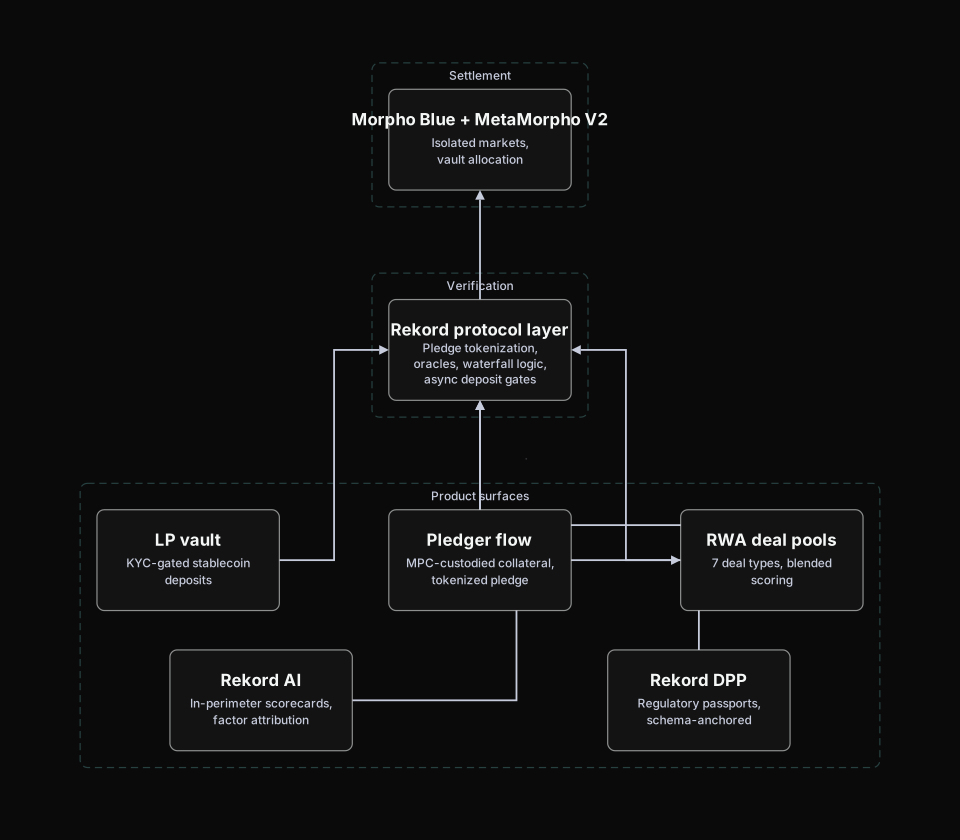
Decision tooling. Rekord AI scores borrowers inside the lender's own perimeter. The model connects to existing data sources (bureaus, banks, internal systems), produces a 0-100 scorecard with factor-level attribution showing which inputs moved the score and by how much, and the underlying data doesn't leave the lender's environment. Nothing leaves the perimeter.
The platform has logged a 95% reduction in time for SMB acquisition finance underwriting analysis, compared to the previous manual workflow.
What changes for you
For an LP, Provable Finance means the credit book you're funding can be inspected at any point without waiting for a statement. For a pledger, it means your collateral stays at your custodian with a continuously attested on-chain representation. For a compliance team, it means filings carry an audit trail a regulator can follow without picking up the phone.
"Verified" stops being something you take on trust and becomes something you check.
For deeper reading, see Three personas: LPs, Collateral Pledgers, and Deals and Why Rekord built on Morpho Blue instead of forking a monolithic lending protocol.